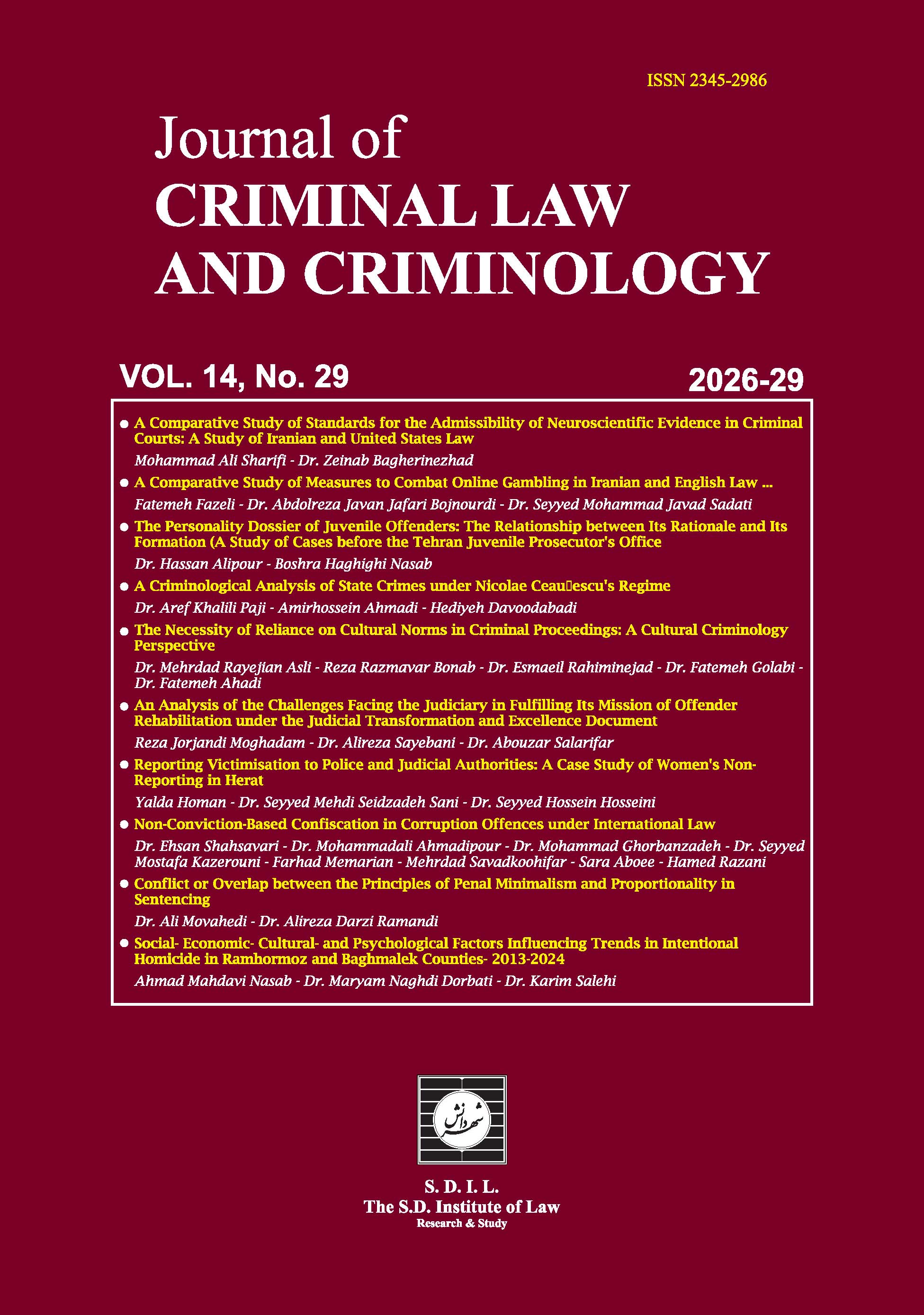
Journal of Criminal Law and Criminology

Journal of Criminal Law and Criminology

*  Publication period: Quarterly

* Type of articles that can be published: Research Article

* Journal rank: Scientific (B)

* The cost of publishing the article: 60,000,000 Rials

* How to issue an article acceptance certificate: by sending an email to the authors

* Type of article acceptance certificate: publication date and DOI code of the article are mentioned

* The name of the similarity finder software used to review articles: hamyab

* Evaluation method: equivalent, double-blind (the referees do not have the authors' information and the authors do not have information about the referees.)

* Duration of initial evaluation of the article: 10 days

* Duration of article evaluation by referees: 3 to 6 months

* How to contact the magazine office: through the contact us section

*  

About the Journal: The Journal of Criminal Law and Criminology Research was first published in 2013 (1392) as a biannual academic journal. In the same year, it was granted a Scientific-Research (Academic) Grade by the Commission for Scientific Journals of Iran.

Since Autumn 2025 (Fall 1404), the journal has been published quarterly, under the authorization of the Ministry of Science, Research and Technology (MSRT).

According to the MSRT Bylaw dated April 29, 2019 (09/02/1398), all academic journals, including The Journal of Criminal Law and Criminology Research, possess official scientific validity.

* How to access the text of the articles: This publication is an Open Access publication and the articles are free to download. 

* How to send the article to the publication? Through the Authors Guide section

This publication is published in cooperation with "The Iranian Association of International Criminal Law" and "Iranian Criminal Law Association" based on the signed memorandum.

The journal is indexed in the Islamic World Science Citation Database (ISC), and Noormags and Magiran.

It should be noted that the journal follows the rules of the International Ethics Committee (COPE).


Current Issue: Volume 14, Issue 28, Spring 2026, Pages 1-198 

Indexing and Abstracting

Keywords Cloud

  • International Criminal Court
  • Criminal policy
  • Prevention
  • Criminal Liability
  • Criminal law
  • Human rights
  • International Crimes
  • Criminology
  • International Criminal Law
  • children
  • Fair trial
  • Criminalization
  • Crimes against humanity
  • criminal responsibility
  • Punishment
  • Prosecutor
  • victim
  • universal jurisdiction
  • Criminal Justice
  • Restorative justice
  • Mediation
  • delinquency
  • Criminal Procedure
  • Juvenile Delinquency
  • Violence
  • Iranian Law
  • State crime
  • Mens Rea
  • criminal justice system
  • Individual Criminal Responsibility
  • International Crime
  • Jurisdiction
  • Genocide
  • Criminal Behavior
  • Islamic Penal Code
  • Legislative Criminal Policy
  • Crime Prevention
  • Iran
  • Sexual Victimization
  • Power
  • Compensation
  • crime
  • Police
  • Extradition
  • Media
  • Cultural Criminology
  • Rape
  • public opinion
  • Evidence
  • terrorism
  • Jurisprudence
  • Deterrence
  • McMenamin
  • Artificial intelligence
  • Criminal Protection
  • Max Weber
  • Realism
  • Mental disorder
  • cooperation
  • rationality
  • Terrorism
  • International Criminal Courts
  • national courts
  • Customary International Law
  • Money Laundering
  • Victimization
  • Legal Person
  • War Crimes
  • Social Emergency
  • International Community
  • Formalism
  • Impunity
  • international responsibility
  • execution of criminal sentences
  • Learning
  • criminal proceedings
  • Judicial Police
  • Rome Statute
  • Women
  • humanitarian law
  • Imprisonment
  • Criminal Law of Cyberspace
  • Challenges
  • Criminal Maturity
  • Transfer of Prisoners
  • Initial Investigations
  • terrorist financing
  • Apology
  • Administrative corruption
  • Children and Adolescents
  • Alternatives to Imprisonment
  • testimony
  • challenge
  • European Arrest Warrant
  • Violence
  • the principle of legality
  • Judicial Independence
  • fear of crime
  • International Documents
  • Islamic Jurisprudence
  • harm
  • Zemiology
  • Individualization
  • Armed Conflict
  • Prison
  • sexual violence
  • Cultural norms
  • International and Regional Documents
  • Responsibility
  • Detention
  • Law
  • Turkish Criminal Law
  • legislation
  • crime against humanity
  • legitimacy
  • Defendant
  • decriminalization
  • ownership
  • Family Violence
  • micro-celebrity
  • claim of influence
  • Drug Attitude Inventory
  • The cause of stronger than the doer
  • Goals
  • primary obligation
  • Situation
  • Customary Criminal Code
  • preventive measures
  • crime predictors
  • special purpose
  • law-making policy
  • Leading a Gang
  • Forensic Linguistics
  • Legality of Proceedings
  • Covert Operations
  • The law on reducing the sentence of probation
  • Managerialism in Criminal Justice
  • Basic Risk Approach
  • Principle of Proportionality
  • the right to privacy
  • Cost
  • humanities
  • Urgent Cases
  • First Pahlavi era
  • self-concept
  • proof beyond reasonable doubt
  • Addiction
  • prosecution
  • Victim’s Rights
  • economic crime
  • Judicial Decision-Making
  • The Principle of Mutual Recognition
  • Unilateral Sanctions
  • Spiritual Health
  • written and spoken authorship
  • The Principle of Harmonization of Laws
  • International Organizations
  • Electronic bracelet
  • wellbeing organization
  • Punishment Reduction Law approved in 1399
  • Death Penalty
  • ICTR
  • cultural lag
  • Nongovernmental organization
  • Maritime Terrorism
  • British law
  • Local community
  • Dangerous State. Gambling and Betting
  • spousal abuse
  • case
  • Tax Recidivism by Taxpayers
  • Sewage
  • Psychology of Terrorists
  • Iranian criminal law
  • legal liability
  • Atonements
  • Costume
  • Deprosecution
  • definition of international terrorism
  • Mastery of Masculine Language
  • Acquittal
  • popular discourse
  • Social
  • Financial Action Task Force Standards
  • Intentional Property Damage
  • the model of welfare
  • Government
  • Accused’s Silence
  • \"Preliminary inquiry\"
  • Administrative Police
  • philosophy
  • Special Permit of Judicial Police
  • judicial precedent
  • Belgian legal system
  • Criminal Inflation
  • \"causation\"
  • Health-Oriented Lifestyle
  • Assessment
  • Crimes against Chastity
  • Cultural Defense